

Blog
Best Sunglasses for Driving in Bangladesh: Why Polarized Lenses Make the Difference

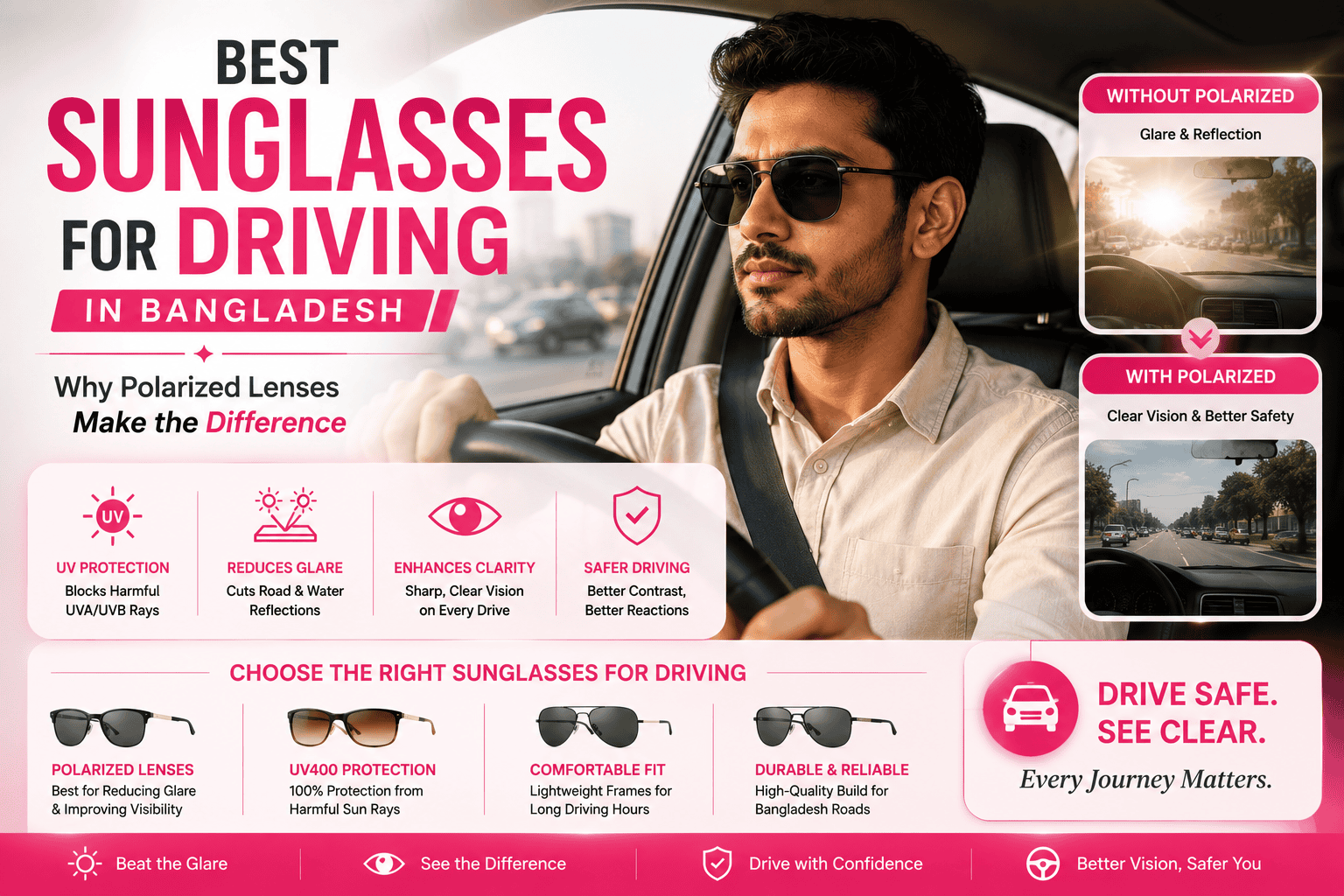
If you drive or ride in Bangladesh, you already know the problem. Sunlight bounces off wet roads, car bonnets, windscreens and glass buildings, hitting your eyes as harsh glare that makes you squint and strains your eyes within minutes. Ordinary dark sunglasses only dim the world; they do not remove that glare. Polarized lenses do. This guide explains why, and how to choose the right pair for the road. Mehboob Optics has protected eyes in Dhaka since 1948.
Why driving glare is a real safety problem
Glare is not just annoying, it is genuinely dangerous. When sunlight reflects off a flat surface like a wet road, it becomes concentrated horizontal light that overwhelms your eyes. In that moment you can lose sight of a pedestrian, a rickshaw or a brake light ahead.
It is worst in exactly the conditions Bangladesh serves up regularly: bright sun after rain, low morning and evening sun straight down a road, and heavy traffic full of reflective metal and glass. Beyond safety, constant squinting causes headaches, tired eyes and fatigue on long drives. Solving glare is not a luxury for drivers; it is a real improvement in both safety and comfort.
How polarized lenses actually work
Ordinary tinted lenses reduce all light equally, like turning down a dimmer switch. They make everything darker, but the glare is still there, just darker. That is why you still squint in cheap sunglasses.
A polarized lens contains a special filter that blocks light travelling in one particular direction, the horizontal direction that reflected glare travels in. It lets the useful vertical light through while cutting the harsh reflected light out. The result is dramatic and immediate: the road surface stops shining, colours look richer, contrast improves and you stop squinting. Once you have driven with Polarized Sunglasses, plain tinted lenses feel obviously inferior on the road.
Polarized is not the same as UV protection
This is the point most people get wrong, and it matters. Polarization handles glare and comfort. UV400 protection blocks the sun’s harmful ultraviolet rays, which can damage your eyes over years and contribute to cataracts.
They are two completely different features, and a lens can have one without the other. A pair can be polarized but offer poor UV protection, or offer UV400 but no polarization. Worse, a very dark lens without UV protection is actively harmful, because the darkness makes your pupils open wider, letting more UV in. For driving in Bangladesh you want both: polarized for glare, UV400 for protection. Always confirm the pair you buy has both.
Which lens tint is best for driving?
Tint changes how you see colour, which matters when you need to read traffic lights and brake lights correctly. Grey is the best all-round choice for driving. It reduces brightness while keeping colours true, so a red light still looks properly red.
Brown and amber tints boost contrast, which helps on hazy or overcast days and makes road edges stand out. Green offers a good balance and is easy on the eyes over long journeys. Avoid strongly coloured tints like blue, pink or dark red for driving, as they can distort traffic signal colours. And avoid very dark lenses if you drive at dawn or dusk, when you need more light, not less.
Never wear polarized or dark lenses at night
This deserves a clear warning. Never wear sunglasses, polarized or otherwise, for night driving. Some shops sell yellow-tinted night driving glasses claiming they reduce headlight glare. In reality, any tint reduces the total light reaching your eyes, and at night you need every bit of light you can get to see pedestrians, cyclists and obstacles.
If headlight glare bothers you at night, the real solution is an anti-glare, anti-reflective coating on your clear prescription glasses, not a tint. That cuts reflections without reducing light. Ask about anti-glare coatings when you order Prescription Eyewear. Keep your windscreen clean inside and out too, as a dirty screen scatters light and makes glare far worse.
Which frame styles work best on the road
Lens quality matters most, but the frame matters too. You want good coverage so light does not leak in from the sides, and a shape that does not block your peripheral vision when you check mirrors and turnings.
Classic Wayfarer Sunglasses are a great all-round driving choice: enough coverage, a clear field of view and a shape that suits most faces. Clubmaster Glasses work well too, though the browline can sit in your eyeline if you have a high driving position, so try before you buy. Wraparound sport styles give the best side coverage for motorbike riders. Thick arms can create blind spots when checking mirrors, so slimmer arms are safer for driving.
Can I get polarized lenses with my power?
Yes, and if you need glasses to drive, this is one of the best investments you can make. A prescription polarized sunglass gives you clear, corrected vision and glare-free comfort in one pair, so you are not switching between glasses and sunglasses at the wheel or driving squinting without correction.
Many frames in the Sunglass range can be fitted with your power, including Sunglass for Him and Sunglass for Her styles. If you drive daily, the pair will earn its cost quickly in comfort and safety. Get your power checked first, tell your optician you want them for driving, and ask specifically for polarized plus UV400. That combination is what actually makes the difference on the road.
Sunglasses for motorbike and rickshaw riders
Riders face everything drivers face, plus wind, dust and insects straight into the eyes. That makes coverage as important as glare control. A wraparound or close-fitting style protects far better than a loose classic frame, because it stops dust and wind coming in at the sides.
Look for impact-resistant lenses, since a stone thrown up by traffic hits far harder at speed. A snug fit matters too, as sunglasses that shift under wind or helmet straps are a distraction. Polarization still helps enormously with road glare, and UV400 remains essential. If you ride daily in Dhaka traffic, treat sunglasses as safety equipment rather than an accessory.
How to check a pair before you buy
A few checks take seconds and save you from a bad pair. First, look for a clear UV400 label or certification. If the shop cannot confirm UV protection, walk away, however dark the lens looks.
Second, test the optical quality. Hold the sunglasses at arm’s length, look through them at a straight line such as a door frame, and move them slowly. If the line bends or wobbles, the lens is distorted and will strain your eyes. Third, check for polarization by looking at a reflective surface and tilting the glasses; a polarized lens will visibly cut the glare as you rotate them. Finally, check the hinges feel firm and the frame sits level on your face.
Sunglasses care so they last the season
Sunglasses live a hard life in Bangladesh: heat, dust, sweat and constant in-and-out of bags. A little care keeps them working. Always remove them with both hands so the frame does not twist and the hinges stay tight.
Store them in a hard case, never loose in a bag with keys. Clean the lenses with a microfibre cloth and lens spray, since a shirt or tissue will scratch the polarizing and UV layers you paid for. Rinse off salt and sweat after a beach or a long ride. And never leave them on a car dashboard, where the heat can warp the frame and damage the lens filter permanently. Treated well, a good pair lasts for years.
Common mistakes drivers make with sunglasses
A few errors are common and easy to fix. The biggest is assuming dark equals safe. A very dark lens without UV400 is worse than no sunglasses at all, because your pupils open wider and let in more ultraviolet light.
Another is wearing tinted lenses at dawn, dusk or night, when you need maximum light. Some drivers also choose heavily coloured tints that distort traffic signal colours, which is genuinely unsafe. Others buy sunglasses with thick arms that block the view when checking mirrors. And many forget that if they need glasses to drive legally, plain sunglasses without their power are not an option. Ask for prescription Polarized Sunglasses instead.
Frequently Asked Questions
Are polarized sunglasses good for driving?
Yes. They are the best choice for driving because they cut the reflected glare from wet roads, car bonnets and windscreens, which reduces squinting and eye strain.
What is the difference between polarized and UV400?
Polarization cuts glare. UV400 blocks harmful ultraviolet rays. They are separate features, and for driving you want a pair with both.
Which lens tint is best for driving?
Grey is the best all-round tint because it keeps colours true. Brown and amber boost contrast on hazy days. Avoid tints that distort traffic light colours.
Can I wear sunglasses for night driving?
No. Never wear tinted lenses at night, as they reduce the light you need to see. Use an anti-glare coating on clear Prescription Eyewear instead.
Can I get polarized sunglasses with my prescription?
Yes. Many frames can take prescription polarized lenses, giving you clear vision and glare-free driving in one pair.
Drive safer: explore Polarized Sunglasses, compare styles in Wayfarer Sunglasses and Clubmaster Glasses, or browse the full Sunglass range.


